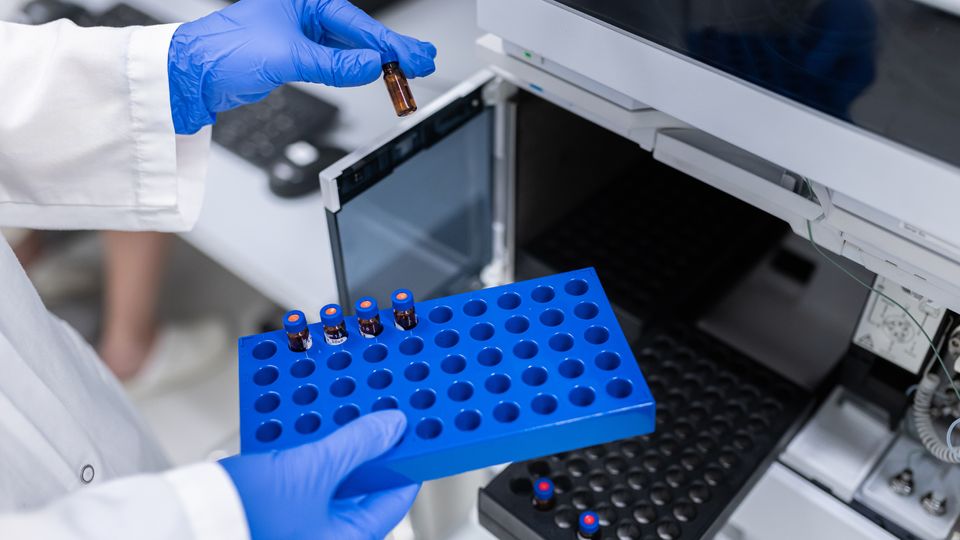
Therapeutic oligonucleotides represent a rapidly growing class of precision medicines, but their complex manufacturing processes demand rigorous quality control (QC) to ensure patient safety and regulatory compliance.
Traditional high-resolution mass spectrometry approaches, while comprehensive, often prove too complex and resource-intensive for routine QC testing environments where speed, reliability and cost-effectiveness are paramount.
This application note demonstrates how advanced unit mass detection technology can deliver the sensitivity and selectivity required for comprehensive purity assessment, enabling routine testing labs to implement a more practical and robust analytical workflow.
What you will learn with this application note:
- How to achieve lower limits of quantification for oligonucleotide impurities
- A validated workflow for distinguishing true impurities from analytical artifacts
- Best practices for implementing automated spectral interpretation
Application Note
Biopharma
Authors
Lee Bertram and Brian Rivera
Agilent Technologies, Inc.
Abstract
This application note outlines a method for assessing the purity of antisense
oligonucleotides (ASOs) using the Agilent InfinityLab Pro iQ Plus LC/MS system.
While high-resolution mass spectrometry is typically employed for analyzing large
biomolecules, such as oligonucleotides, the LC/MS approach described here
enables the use of a unit mass detector in a more robust and routine fashion. The
Agilent Oligo Analysis Accelerator (OAA) enhances peak integration and spectral
interpretation, streamlining the quality control workflow. This method supports rapid
analysis of oligonucleotide purity, assay performance, and basic impurity profiling.
Assessing the Purity of an Antisense
Oligonucleotide Sample by LC/MS
Using a high-sensitivity unit mass detector
2
Introduction
Antisense oligonucleotides (ASOs) are an established
therapeutic nucleic acid modality, manufactured by
solid‑phase synthesis. Because of their complexity,
a common way to assess the purity of ASOs is liquid
chromatography/mass spectrometry (LC/MS). Although
high-resolution MS might be appropriate for workflows such
as characterization and sequence confirmation, unit mass
detection provides a more robust and practical method for
routine testing labs.
Single quadrupole LC/MS has previously been shown to
effectively support purity, assay, and impurity profiling for
routine testing of single-stranded therapeutic oligos, such
as ASOs.1
This method relies on MS full scan to quantitate
closely related impurities that elute under the main peak. The
LC/MS conditions ensure that analytes are predominantly
in the 4– charge state when entering the gas phase. For
example, an oligo that is ~ 8 kDa would have a predominant
m/z value of ~ 2,000. This would either be at the upper limit or
possibly exceed the scan range for some unit mass detectors.
Furthermore, this method has a limit of quantitation (LOQ) of
≥ 0.2%, requiring a sensitive mass detector with efficient high
mass transmission.
In this application note, the Agilent InfinityLab Pro iQ Plus
LC/MS system is used to determine the purity of an ASO.
The full scan spectrum from this unit mass detector enables
the identification and quantification of low-level impurities
at method specifications. This study establishes proof of
concept for the use of this system in the routine testing of
oligonucleotides for QC lot release.
Experimental
Instrument configuration
This experiment was conducted using the following
instrument configuration:
– Agilent InfinityLab Pro iQ Plus LC/MS system (G6170A)
– Agilent 1290 Infinity II bio binary pump (G7120A)
– Agilent 1290 Infinity II bio multisampler (G7167B)
– Agilent 1290 Infinity II bio column compartment (G7116B)
– Agilent 1260 Infinity II diode array detector HS (G7117C)
Although this analysis used an Agilent Infinity II LC
configuration, comparable results can be achieved on
the Agilent Infinity III LC system with no changes to
method parameters.
Sample preparation
A 20-mer, non-HPLC purified antisense oligo (ASO-1) was
obtained from Integrated DNA Technologies (Coralville, IA,
USA). Samples were reconstituted in de-ionized water
to 1 mg/mL, then further diluted to 0.1 mg/mL in
de-ionized water.
Software
Data acquisition was performed in Agilent OpenLab CDS,
version 2.8, using the LC/MS parameters shown in Tables 1
and 2. Data analysis was performed in Oligo Analysis
Accelerator (OAA) for OpenLab CDS, version 1.0.
LC/MS settings
Table 1. Source parameters for the Agilent InfinityLab Pro iQ Plus (6170A).
Mass Spectrometry Parameters
MS 6170A
Source Electrospray ionization (ESI)
Scan Mode Negative polarity
Drying Gas Flow 12.0 L/min (standard)
13.0 L/min (harsh)
Gas Temperature 260 °C (standard)
350 °C (harsh)
Nebulizer Pressure 25 psi
Capillary Voltage 4,000 V
Scan m/z 1,450 to 2,175
Scan Time 1,000 ms
Fragmentor 100 V
Gain Factor 1
Table 2. HPLC parameters.
Parameter Value
Column Agilent AdvanceBio Oligonucleotide, 2.1 × 150 mm,
2.7 µm (p/n 659750-702)
Sampler Temperature 8 °C
UV Detection 260/4 nm (Ref 400/80 nm)
Peak width > 0.05 min (5 Hz)
Mobile Phase A 10% ACN, 5 mM tributylammonium acetate, 1 µM EDTA
Mobile Phase B 80% ACN, 5 mM tributylammonium acetate, 1 µM EDTA
Flow Rate 0.25 mL/min
Multi Wash 20:80 Water:methanol, flush port, 5 seconds
90:10 Water:methanol, flush port, 3 seconds
Column Temperature 50 °C
Post Time 1.0 min
Gradient Program
Time (min) %B
0 45
22 80
25 80
26 45
3
Results and discussion
This method demands exceptional sensitivity, precision, and a
broad mass range, making the Agilent InfinityLab Pro iQ Plus
an ideal solution for the task. To determine the purity of an
ASO, a full scan spectrum is extracted from the main peak,
which tends to be broad (2 to 3 minutes) due to the shallow
gradient program. Any m/z values in the average spectrum
that exceed an established threshold can then be used to
generate an extracted ion chromatogram (EIC). The limit
of quantification (LOQ) is established at 0.2%, and because
many impurities are near isobaric, any spectral overlap may
interfere with the data. Thus, a sensitive and selective method
is required for this analytical workflow.
The Pro iQ Plus has a mass range of m/z 2 to 3,000. This
method typically requires a full scan of m/z ± 150 around
the 4– charge state of the full-length product (FLP). For
example, an oligo with a molecular weight of 8,000 Da would
require a scan range from m/z 1,750 to 2,150. Additionally,
sufficient ion transmission at higher m/z values is important,
as EICs are used for the relative quantitation of each impurity.
Figure 1 shows the ion transmission stability for mass axis
assignment and peak width at m/z 2,234, monitored over
24 hours. These data demonstrate the robustness and
stability of large molecule transmission on the Pro iQ Plus.
Prior to selecting the ions that exceed the threshold for EIC
integration, the method requires a comparison of the sample
under different MS conditions. Figure 2 shows the overlay
of so-called "standard" and "harsh" spectra from the ASO-1
sample. This overlay of spectra on a relative scale is used to
determine if any ions exceeding the threshold are adducts.
Ions that exceed the threshold under standard conditions, but
not under harsh conditions, are regarded as adducts. This is
because the higher temperature conditions used for harsh
conditions minimize adduct formation during electrospray
desorption of the ASO. The spectra obtained under both
conditions demonstrate excellent selectivity and sensitivity for
the ions in the 4– charge state.
2,233.0
2,233.2
2,233.4
2,233.6
2,233.8
2,234.0
2,234.2
2,234.4
2,234.6
2,234.8
2,235.0
0246 8 10 12 14 16 18 20 22 24
Mass axis assignment (m/z)
Time (hours)
Time (hours)
Mass axis assignment for m/z 2,234 (24 hours)
0.4
0.5
0.6
0.7
0.8
0.9
1.0
1.1
0 2468 10 12 14 16 18 20 22 24
Peak width assignment (FWHM)
Peak width assignment for m/z 2,234 (24 hours)
Figure 1. Mass axis assignment (m/z) and peak width (FWHM) of the
calibrant ion (m/z 2,234) monitored over a continuous, 24-hour time
period to demonstrate the stability of large molecule transmission on the
Agilent Pro iQ Plus.
4
Table 3 shows the ions identified using the OAA algorithm.
These ions exceed thresholds under both standard and
harsh conditions, with any "known" ions being within
m/z ± 0.5 of values in the imported ion list. Interestingly,
several unknown ions with m/z values greater than the
FLP are observed. These may be longmers (for example,
n + 1) or other process‑related impurities. These again are
not chromatographically resolved, and thus it is critically
important that they are measured by the MS detector.
The ions in Table 3 were used to generate EICs, which were
then integrated into the next step. This information is required
for two purposes. First, the relative peak areas are used to
calculate the MS purity of the peak. Second, the earliestand latest-eluting impurities are used to determine the UV
integration of the main peak (Figure 3). Thus, both MS and
UV purities can be used to determine the overall purity of the
ASO sample.
Figure 2. Overlay of ASO-1 full scan spectra under standard (teal) and harsh (violet) conditions. The Oligo Analysis Accelerator software user
interface enables direct inspection of the overlaid spectra. Dashed lines indicate the thresholds: 0.2% "prepeak" (m/z values less than the 4–
charge state of the full-length product) and 0.3% "postpeak" (m/z values greater than the 4– charge state of the full-length product). The software
then automatically classifies ions accordingly based on whether the harsh-condition ions are still above the threshold. Relative abundance (%)
Mass-to-charge (m/z)
0
0.5
1.0
1.5
2.0
2.5
3.0
3.5
1,800 1,820 1,840 1,860 1,880 1,900 1,920 1,940
5
Figure 3. Extracted ion chromatogram integration within the Oligo Analysis Accelerator software, which allows for direct integration
within the application. The m/z 1,650 ion (unknown) is used to determine the integration of the UV peak. The start of integration for the
earliest‑eluting impurity is applied as the start of integration for the UV peak, with UV and MS retention time offsets also considered in this
automated calculation. Relative abundance (%)
Retention time (min)
0
10
20
30
40
50
60
70
80
90
100
11.0 11.5 12.0 12.5 13.0 13.5 14.0 14.5 15.0 15.5 16.0 16.5
Table 3. Classified ions from ASO-1 that exceed method thresholds.
Name m/z
Full-Length n 1,826.3
Full-Length n (P=O)1*/Loss of Methylene 1,822.3
N – p(MOE A) 1,725.5
N – p(MOE MeU)/n – p(MOE MeC) 1,727.9
N – p(dA) 1,744
Abasic Depurination Species (Loss of Ade + H2
0) 1,797
n + p(dA) 1,908.5
n + p(dG) 1,912.5
Dithioate/Thioate 1,830.2
Name m/z
N3-(2-cyanoethyl)thymine (CNET) 1,839.5
Unknown 1,884.4
Unknown 2,087.1
Unknown 1,857.8
Unknown 1,651.1
Unknown 1,902.4
Unknown 1,774.1
Unknown 1,843.7
Unknown 1,850.7
6
Retention time (min)
0
5
10
15
20
25
30
35
40
Response (mAU)
9 10 11 12 13 14 15 16
UV Integration
Figure 4. UV integration of the main peak, based on EIC integration for early- and late-eluting impurities.
www.agilent.com
DE-006965
This information is subject to change without notice.
© Agilent Technologies, Inc. 2025
Printed in the USA, June 13, 2025
5994-8405EN
The relative peak areas for each EIC are shown in Table 4.
The resulting MS purity of 86.9% contrasts with the calculated
UV purity of 98.0% (Table 5). Although this method was
developed to allow for the coelution of closely related
impurities, chromatographic method development may
help ensure more accurate quantitation. This is especially
important considering that many of the unknown impurities
are likely n – 1 or alkylated impurities, which elute later than
the FLP. In either case, a sensitive and selective MS detector
is crucial for determining the purity of an oligonucleotide.
Table 4. Relative peak area results for all ions.
Name m/z Category EIC Peak Area (%)
Full-Length n 1,826.3 Full-length n 85.126
Full-Length n (P=O)1*/Loss
of Methylene 1,822.3 Full-length (P=O) 2.184
n – p(MOE A) 1,725.5 n – 1 0.197
n – p(MOE MeU)/n –
p(MOE MeC) 1,727.9 n – 1 0.489
Abasic Depurination Species
(Loss of Ade + H2
O) 1,797 Abasic 0.271
n + p(dA) 1,908.5 n + 1 0.271
n + p(dG) 1,912.5 n + 1 0.578
n + p(MOE MeU)/n +
p(MOE MeC) 1,924.6 n + 1 0.338
n + p(MOE A) 1,927 n + 1 0.663
n + p(MOE + G) 1,931 n + 1 0.624
Dithioate/Thioate 1,830.2 Others 0.688
N3-(2-cyanoethyl)thymine
(CNET) 1,839.5 Others 0.21
Unknown 1,884.4 – 1.831
Unknown 2,087.1 – 0.59
Unknown 1,857.8 – 0.545
Unknown 1,913.8 – 0.614
Unknown 1,651.1 – 0.334
Unknown 1,902.4 – 0.47
Unknown 1,774.1 – 0.453
Unknown 1,843.7 – 0.356
Unknown 1,850.7 – 0.25
Unknown 1,749.7 – 0.256
Unknown 1,833.4 – 0.216
Unknown 1,478.4 – 0.242
Unknown 1,457 – 0.162
Unknown 1,507.4 – 0.113
Table 5. UV and MS purity results.
Criteria Result Expected Result
UV Purity 98.0% 98.0%
MS Purity 86.9% –
Most Abundant Mass (Da) 7,307.6 7,307.4
Conclusion
This method, as cited in previous literature1
, has become the
gold standard for LC/MS-based purity, assay, and impurity
profiling of therapeutic, single-stranded oligonucleotides. The
method requires a selective and sensitive detector capable
of acquiring full scan spectra from the main peak to ensure
accurate quantitation of impurities. Additionally, depending
on sample, the method may require scans above m/z 2,000,
which is a limiting factor for many unit mass detectors.
Due to its excellent ion transmission at high mass ranges,
the Agilent InfinityLab Pro iQ Plus can meet these method
requirements for both sensitivity and selectivity, thereby
allowing QC analysis of oligonucleotide impurities.
Reference
1. Rentel, C.; Gaus, H.; Bradley, K.; Luu, N.; Kolkey, K.; Mai, B.;
Madsen, M.; Pearce, M.; Bock, B.; Capaldi, D. Assay, Purity,
and Impurity Profile of Phosphorothioate Oligonucleotide
Therapeutics by Ion Pair–HPLC–MS. Nucleic Acid
Ther. 2022, 32(3), 206–220. DOI: 10.1089/nat.2021.0056