Eco-Friendly UV Chip Keeps Food Fresher for Longer
Unlike conventional UV lamps, the chip doesn't use mercury or require warm-up time and is only a few centimeters in size
Complete the form below to unlock access to ALL audio articles.
A compact chip has been developed that emits ultraviolet (UV) light for disinfection. The innovation has been incorporated into various food applications to inactivate microorganisms in food to keep it fresh. Unlike conventional UV lamps, the chip does not use mercury, is flat and only a few centimeters in size.
The work, led by Prof. Hilmi Volkan Demir, director of LUMINOUS! and professor at Nanyang Technological University, Singapore (NTU Singapore)’s School of Electrical and Electronic Engineering, School of Physical and Mathematical Sciences and School of Materials Science and Engineering, and Swedish technology company PureFize Technologies, was published in Advanced Optical Materials.
A need for safe, instant and effective UV disinfection
UVC – light at the shortest wavelength of the UV spectrum – is most effective for inactivating most microorganisms, as it damages the DNA and kills the microorganism.
Mercury lamps that emit UVC are commonly used for disinfection. However, due to mercury’s high toxicity, initiatives such as the Minamata Convention on Mercury are phasing out the use of mercury and encouraging the development of environmentally friendly disinfection technologies.
There is also an unmet need for UV disinfection technologies that can operate instantly for immediate disinfection, unlike mercury lamps that require time to warm up. To address these challenges, the team sought to develop a mercury-free UV source for everyday applications that is compact, effective and can be switched on instantly.
Zapping harmful microorganisms
The team designed a chip (Figure 1) that emits a broad spectrum of UV (250–350nm), with a UVC peak at 262 nm and a UVB peak at 295nm. UVC disrupts DNA, while UVB and UVA destroy microbial biofilms as well as cellular components like proteins and lipids.

Figure 1: Photo of the UV chip. Credit: NTU Singapore.
The UV light is produced via cathodoluminescence – when a voltage is applied, electrons from the cathode in the chip are accelerated toward the anode, which emits UV when excited by electrons.
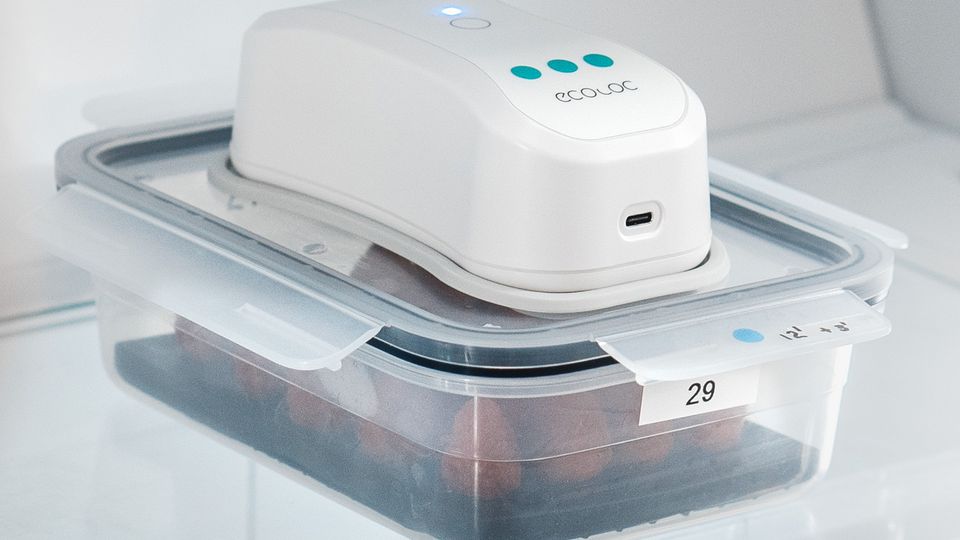
The chip has been incorporated into a commercial handheld device called EcoLocTM, designed to work with a specially designed lid that fits the IKEA 365+TM range of food containers. Users can switch on EcoLoc for a few minutes before refrigerating food to eliminate food spoilage microorganisms.
The researchers evaluated the UV chip’s performance across a wide range of operating temperatures relevant to various appliances – conditions where traditional mercury lamps fall short.
Independent microbiology labs and universities tested the chip’s ability to inactivate several unwanted microorganisms, including Pseudomonas aeruginosa (P. aeruginosa), Escherichia coli (E. coli), Legionella pneumophila (L. pneumophila) and SARS-CoV-2. Additionally, at the PureFize UV and food science lab in Stockholm, researchers evaluated its impact on the shelf life and sensory properties of various perishable foods, including raspberries, strawberries and fresh chicken.
The key findings of the paper were:
- The disinfection efficiency of the UV chip was on par with conventional mercury lamps.
- The UV chip maintains consistent performance from −20–100 °C, whereas mercury lamps operate optimally only within 35–55 °C.
- The UV technology effectively and rapidly reduced pathogens P. aeruginosa, E. coli and L. pneumophila.
- The UV technology also effectively eliminated SARS-CoV-2, the virus responsible for COVID-19.
- Using the chip, the shelf-life of various perishable foods, including fruits and meats, was extended to almost a week with minimal changes in taste and odor.
Keeping food safe and preventing infectious disease outbreaks
This innovation is a breakthrough in health and safety as it has the potential to eradicate harmful food spoilage microorganisms as well as reduce the spread of infectious diseases such as COVID-19. By reducing the amount of food waste generated, this UV technology will also contribute to a greener tomorrow. Addressing the drawbacks of mercury lamps, this innovation complements the range of available UV technologies on the market.
It should be noted that the disinfection efficacy of UV technologies can vary with environmental conditions such as humidity, surface irregularities and light obstruction. Surfaces that are shaded, uneven or partially blocked may not receive sufficient UV dosage, reducing overall effectiveness. However, the broad-spectrum UV light emitted by the chip allows for greater penetration. This includes some coverage of shadowed areas that UVC alone cannot reach.
Care must also be taken when using devices that emit UV light as UV radiation can damage human skin and eyes. To prevent accidental exposure, EcoLoc is equipped with sensors and will only be activated when attached to the container lid. It will not function at all when removed from the lid.
Ushering in a cleaner and greener tomorrow
The UV chip has now been integrated into PureFize’s new modular UV platform, PureFize VelonTM, which is currently being deployed in various business-to-business applications to improve food safety and quality. The researchers are also exploring other disinfection applications of the chip.
Reference: Sharma VK, Tan ST, Zheng H, et al. On-chip mercury-free deep-UV light-emitting sources with ultrahigh germicidal efficiency. Adv. Opt. Mater. 2021; 9(15): 2100072. doi:10.1002/adom.202100072
Have you recently published research?
You can raise awareness of your work with an article like this too.