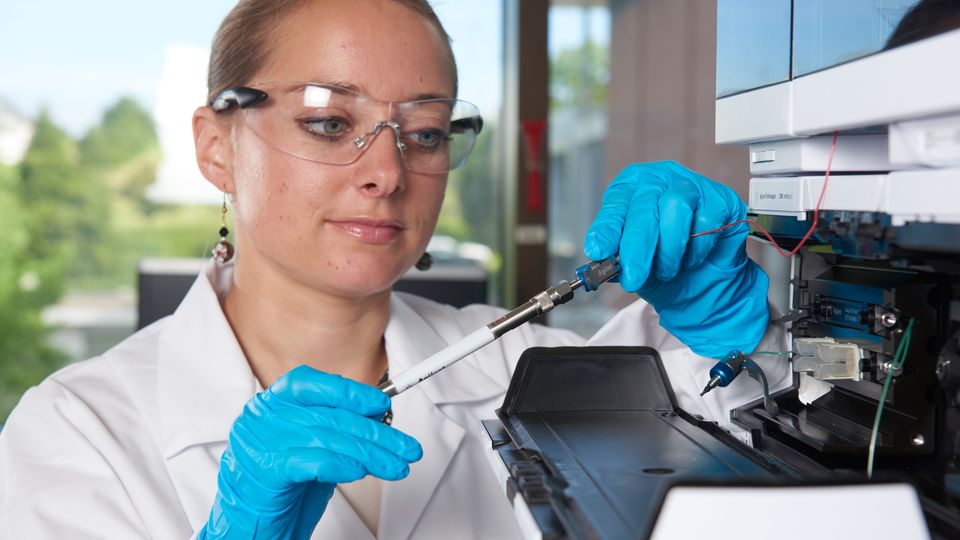
Size exclusion chromatography (SEC) has become the gold standard for aggregate analysis of biotherapeutic molecules, but oligonucleotides present unique analytical challenges.
Unlike proteins with compact structures, oligonucleotides are larger, more flexible molecules that can exist as single- or double-stranded forms with complex secondary structures including loops and hairpins.
This application note provides expert guidance on choosing the right SEC columns and optimizing method conditions to achieve reliable oligonucleotide separations.
Download this application note to learn discover:
- How to select appropriate pore size columns based on oligonucleotide size ranges
- Method optimization strategies including mobile phase selection and flow rate considerations
- Key differences between DNA and RNA behavior in SEC systems
Application Note
Biopharma/Pharma
Authors
Andy Coffey, Anne Blackwell,
and Charu Kumar
Agilent Technologies, Inc.
Abstract
The use of analytical size exclusion chromatography (SEC) for the separation
of oligonucleotides from other components based on hydrodynamic radius is
complicated by the range of sizes that can be present, as well as fundamental
differences in the conformation between DNA and RNA. This makes selecting the
correct pore size SEC column more challenging.
Using oligonucleotide ladders, often developed for electrophoresis calibration,
makes understanding the pore structure of SEC columns easier, but it remains
essential to perform thorough method optimization to overcome challenges
with some molecules. This application note provides guidance in choosing the
appropriate pore size columns for oligonucleotide separations.
Choosing Appropriate Pore Size
Columns for Size Exclusion
Chromatography of Oligonucleotides
2
Introduction
SEC has become the method of choice
for aggregate analysis of biotherapeutic
molecules. Unlike proteins, which
generally have a compact structure,
oligonucleotides are much larger. They
may be single- or double-stranded, and
they may have a complex structure
containing loops and hairpins. These
structures may also vary depending on
the conditions used for analysis.
This study used SEC of oligonucleotide
standards available in a wide range of
sizes. These sizes corresponded to
differing dimensions in solution that
covered the entire resolving range of
the columns used in the study. This
allowed a direct comparison of the
chromatographic properties of each
column, such as exclusion limit (rather
than pore size) based on the number
of nucleotides.
Although oligonucleotides are highly
hydrophilic, they can exhibit secondary
interactions through hydrogen bonding
or from ionic interactions. Also, variations
that introduce hydrophobic modifications
such as labels can also cause secondary
interactions. It is therefore advisable to
screen different mobile phase conditions
to ensure robust methodology.
Experimental
Reagents and chemicals
All reagents were HPLC grade or higher.
Instrumentation
Data acquisition was performed on
an Agilent 1260 Infinity II bio-inert
LC system using Agilent OpenLab
CDS software.
Sample preparation
DNA Ladder standards (part numbers
S7025 and D0428) were purchased from
Merck Sigma-Aldrich, dissolved in mobile
phase, and stored frozen until needed.
RiboRuler HR was purchased from
Thermo Fisher and diluted 1:10 in mobile
phase before use.
Mobile phase preparation
Three different mobile phase solutions
were investigated. These were
prepared by dissolving the necessary
compounds in Milli-Q water, then filtering
through a 0.22 µm membrane filter.
The eluents were:
– 150 mM sodium phosphate, pH 7.0
– 2X PBS (approximately 20 mM
phosphate + 280 mM NaCl), pH 7.4
– 50 mM potassium phosphate,
200 mM potassium chloride, pH 7.0
Parameter Value
Column See Table 2
Mobile Phases
– 150 mM sodium phosphate,
pH 7.0; or
– 2X PBS (approximately
20 mM phosphate +
280 mM NaCl), pH 7.4; or
– 50 mM potassium
phosphate, 200 mM
potassium chloride, pH 7.0
Flow Rate 0.35 or 0.175 mL/min
Column Temperature 30 °C
Injection Volume 5 µL
Total Run Time 30 minutes per injection
Detection UV, 260 nm
Table 1. HPLC method conditions.
Column Description
A Agilent AdvanceBio SEC 500 Å,
4.6 × 300 mm, 2.7 µm
B Agilent AdvanceBio SEC 1000 Å,
4.6 × 300 mm, 2.7 µm
C Waters GTxResolve Premier SEC 1,000 Å,
4.6 × 300 mm, 3 µm
Table 2. Columns tested.
50 bp DNA Ladder 1 kb DNA Ladder
50 bp 500 bp
100 bp 1,000 bp
150 bp 1,500 bp
200 bp 2,000 bp
250 bp 2,500 bp
300 bp 3,000 bp
350 bp 4,000 bp
400 bp 5,000 bp
450 bp 6,000 bp
500 bp 8,000 bp
600 bp 10,000 bp
700 bp
800 bp
900 bp
1,000 bp
2,000 bp
3,000 bp
Table 3. DNA standards used.
3
Results and discussion
The first experiment was to determine if
using a slower flow rate would improve
chromatographic performance as very
large molecules diffuse more slowly.
Figure 1 shows the separation of a
50 bp DNA ladder performed at 0.175
and 0.35 mL/min. The latter is the flow
rate normally used with 4.6 mm id
SEC columns.
The main difference was the peak height
– at the lower flow rate, the peaks spent
longer in the detector flow cell, resulting
in a greater response. Other factors such
as peak width and resolution appeared to
be very similar.
However, when testing larger
oligonucleotides using the 1 kb DNA
ladder (Figure 2), the peak response
was similar, confirming that larger
molecules have slower diffusion times.
Consequently, the resolution of the
largest molecules was improved, and
subsequent experiments were performed
using the lower flow rate. Figure 3
shows the separation of the 1 kb DNA
ladder using the Agilent AdvanceBio
SEC 1000 Å, 2.7 µm column with three
different mobile phase solutions as
described in Table 1. The total buffer/salt
concentration was either 150 or 300 mM,
ensuring that nonspecific secondary
interactions were minimized. The
molecules eluted at almost the same
retention time (RT) with very similar
peak shape and resolution. The 2X PBS
mobile phase conditions were used for
creating the calibration data plots shown
in Figure 4. Individual retention times are
listed in Table 4 and were determined by
integration of chromatograms shown in
Figure 5.
Figure 1. Separation of a 50 bp DNA ladder on an Agilent AdvanceBio SEC 1000 Å (column B),
mobile phase 2X PBS.
123456789 10 11 12 13 14 15
Retention time (min)
–0.5
0.0
0.5
1.0
1.5
2.0
Response (mAU)
1 23456789 10 11 12 13 14 15 16 17 18 19 20 21 22 23 24 25 26 27 28 29 30
Retention time (min)
–0.5
0.0
0.5
1.0
1.5
2.0
Response (mAU)
0.35 mL/min
0.175 mL/min
Figure 2. Separation of a 1 kb DNA ladder on an Agilent AdvanceBio SEC 1000 Å (column B),
mobile phase 2X PBS.
123456789 10 11 12 13 14
Retention time (min)
0
0.5
1.0
1.5
2.0
Response (mAU)
123456789 10 11 12 13 14 15 16 17 18 19 20 21 22 23 24 25 26 27 28 29
Retention time (min)
0
0.5
1.0
1.5
2.0
Response (mAU)
0.35 mL/min
0.175 mL/min
×101
×101
Figure 3. Separation of a 1 kb DNA ladder on an Agilent AdvanceBio SEC 1000 Å (column B) showing the
effect of mobile phase.
12345678 9 10 11 12 13 14 15 16 17 18 19 20 21 22 23 24 25 26 27 28 29
Retention time (min)
150 mM sodium phosphate, pH 7.0
2X PBS, pH 7.4
50 mM KPO + 200 mM KCl, pH 7.0
4
dsDNA (bp)
RT (min)
Column A Column B Column C
3,000
9.10
9.81
2,000 10.21 11.24
1,000 12.02
900 9.81 12.48 12.54
800 9.97 12.92 12.75
700 10.27 13.56 13.17
600 10.67 14.26 13.62
500 11.19 15.05 14.16
450 11.57 15.57 14.50
400 11.98 16.02 14.85
350 12.59 16.72 15.38
300 13.26 17.44 15.91
250 14.11 18.18 16.53
200 15.10 18.90 17.19
150 16.42 19.84 18.04
100 18.25 20.94 19.17
50 20.17 22.05 20.30
Table 4. Retention times of DNA ladder peaks.
Figure 4. Oligonucleotide calibration curve comparison.
10
100
1,000
10,000
8 10 12 14 16 18 20 22 24 26
Nucleotides (bp)
Retention time (min)
Column A, AdvanceBio SEC 500 Å Column B, AdvanceBio SEC 1000 Å Column C
Figure 5 . Chromatograms of a 50 bp DNA ladder using (A) column A, Agilent AdvanceBio SEC 500 Å; (B)
column B, AdvanceBio SEC 1000 Å; and (C) column C, with mobile phase 2X PBS, pH 7.4.
-0.1
0.0
0.1
0.2
0.3
0.4
0.5
0.6
0.7
0.8
0.9
1.0
Response (mAU)
1 2 3 4 5 6 7 8 9 10 11 12 13 14 15 16 17 18 19 20 21 22 23 24 25 26 27 28 29 30
Retention time (min)
50 bp
100 bp
150 bp
200 bp
250 bp
300 bp
350 bp
400 bp
500 bp
450 bp
600 bp
700 bp
800, 900 bp
1,000, 2,000 bp
×101
A
-0.2
0.0
0.2
0.4
0.6
0.8
1.0
1.2
1.4
1.6
1.8
2.0
Response (mAU)
1 2 3 4 5 6 7 8 9 10 11 12 13 14 15 16 17 18 19 20 21 22 23 24 25 26 27 28 29
Retention time (min)
50 bp
100 bp
150 bp
200 bp
250 bp
300 bp
350 bp
400
500
bp
bp450 bp
600 bp
700 bp
800 bp
900 bp 1,000 bp
2,000 bp 3,000 bp
B
0.0
0.1
0.2
0.3
0.4
0.5
0.6
0.7
0.8
0.9
1.0
Response (mAU)
1 2345678 9 10 11 12 13 14 15 16 17 18 19 20 21 22 23 24 25 26 27 28 29 30
Retention time (min)
50 bp
100 bp
150 bp
200 bp
250 bp
300 bp
350 bp
400 bp
500 bp
450 bp
600 bp
700 bp
800, 900, 1,000 bp
2,000 bp
×101
C
5
Figure 6 shows chromatograms of
the 1 kb DNA ladder standard run
on both 1,000 Å pore size columns,
illustrating the difference in pore
volume (from exclusion point to total
permeation point).
In contrast, Figure 7 shows the
chromatogram from an RNA ladder. RNA
is most commonly single-stranded and
the size is expressed in terms of number
of nucleotides (nt) instead of base pairs
(bp) used when describing DNA. One
might expect a single strand of RNA
containing 2,000 nucleotides to have the
same size as a double-stranded DNA
(dsDNA) molecule containing 2,000 base
pairs. However, the double helix nature
of the dsDNA appears to restrict the
conformation that the molecule is able to
adopt. Single-stranded RNA appears to
be much more flexible and able to adopt
a smaller size in solution than DNA, and
therefore elutes later.
This behavior has been noted previously.1
It is also important to take into
consideration the likely need to either
increase the denaturing conditions (for
instance by increasing the temperature,
or to include a chaotrope in the mobile
phase) to improve peak shape for RNA
molecule separations.
Figure 6. Chromatograms of a 1 kb DNA Ladder for 1000 Å columns B and C (mobile phase 2X PBS,
pH 7.4) showing the difference in pore volume.
×101
×101
A
B
1 23456789 10 11 12 13 14 15 16 17 18 19 20 21 22 23 24 25 26 27 28 29
1 23456789 10 11 12 13 14 15 16 17 18 19 20 21 22 23 24 25 26 27 28 29
Retention time (min)
0
0.2
0.4
0.6
0.8
1.0
1.2
1.4
1.6
Response (mAU) Response (mAU)
Column B
Agilent AdvanceBio
SEC 1000 Å
Exclusion point
Permeation point
0
0.2
0.4
0.6
0.8
1.0
1.2
1.4
1.6
Column C
20% less pore volume
Figure 7. RiboRuler HR RNA Ladder on column A, Agilent AdvanceBio SEC 500 Å.
12345678 9 10 11 12 13 14 15 16 17 18 19 20 21 22 23 24 25 26 27 28 29
Retention time (min)
0
1
2
3
4
5
6
7
8
9
Response (mAU)
200 nt
500 nt
1,500 nt
2,000 nt
3,000 nt
4,000 nt
6,000 nt
1,000 nt
www.agilent.com
DE-004830
This information is subject to change without notice.
© Agilent Technologies, Inc. 2025
Printed in the USA, March 12, 2025
5994-8198EN
Conclusion
The columns used in this study are
the latest Agilent AdvanceBio SEC
columns in 500 and 1000 Å pore sizes,
which provide exceptional pore volume
for maximizing the useful range of
oligonucleotides that can be separated.
It is difficult to compare the resolving
range of globular proteins to the
resolving range of oligonucleotides, but
a useful indication comes from the pore
size of the column. For example, 500 Å
pore size columns are suitable for DNA
up to approximately 500 to 1,000 bp
while 1000 Å pore size columns are
suitable for DNA up to approximately
2,000 to 3,000 bp (Figure 8).
Reference
1. Schneider, S.; Rieck, F. SEC-MALS
for mRNA Characterization with the
Agilent 1260 Infinity II Multi-Angle
Light Scattering Detector, Agilent
Technologies application note,
publication number 5994-7745EN,
2024.
Figure 8. Expected DNA and RNA resolving ranges of molecules for different pore size columns using
Agilent AdvanceBio columns.
AdvanceBio SEC 1000 Å
AdvanceBio SEC 500 Å
AdvanceBio SEC 300 Å
10 100 1,000 10,000
DNA size (bp)
DNA resolving range
AdvanceBio SEC 1000 Å
AdvanceBio SEC 500 Å
AdvanceBio SEC 300 Å
10 100 1,000 10,000
RNA size (nt)
RNA resolving range